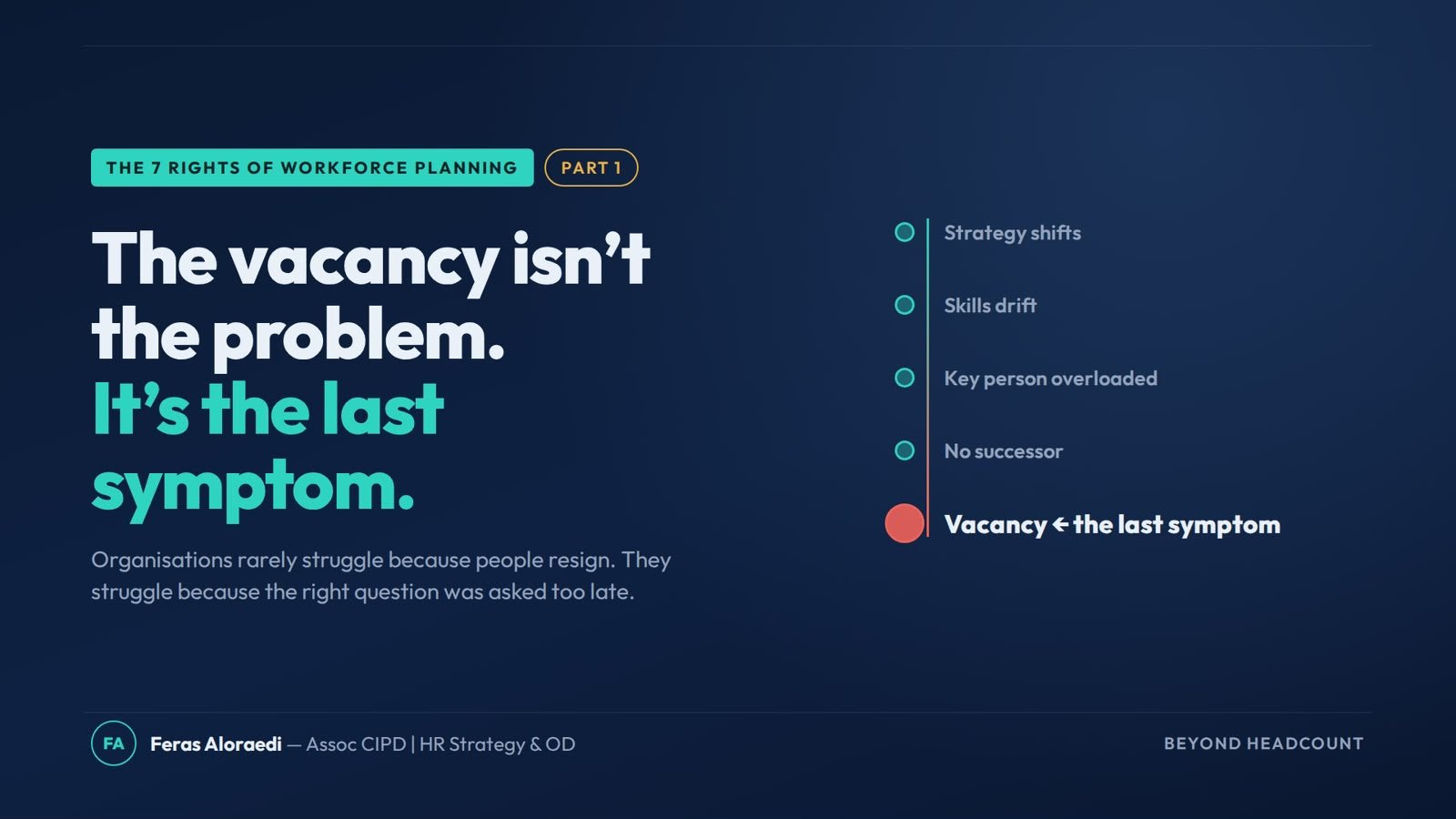

Most organisations don’t have a hiring problem. They have a question-order problem.
We ask: “How many people do we need?” It’s a legitimate question. It just arrives too late.
The question that should come first is: “What capability do we need to deliver our strategy?“
A vacancy is an operational event.
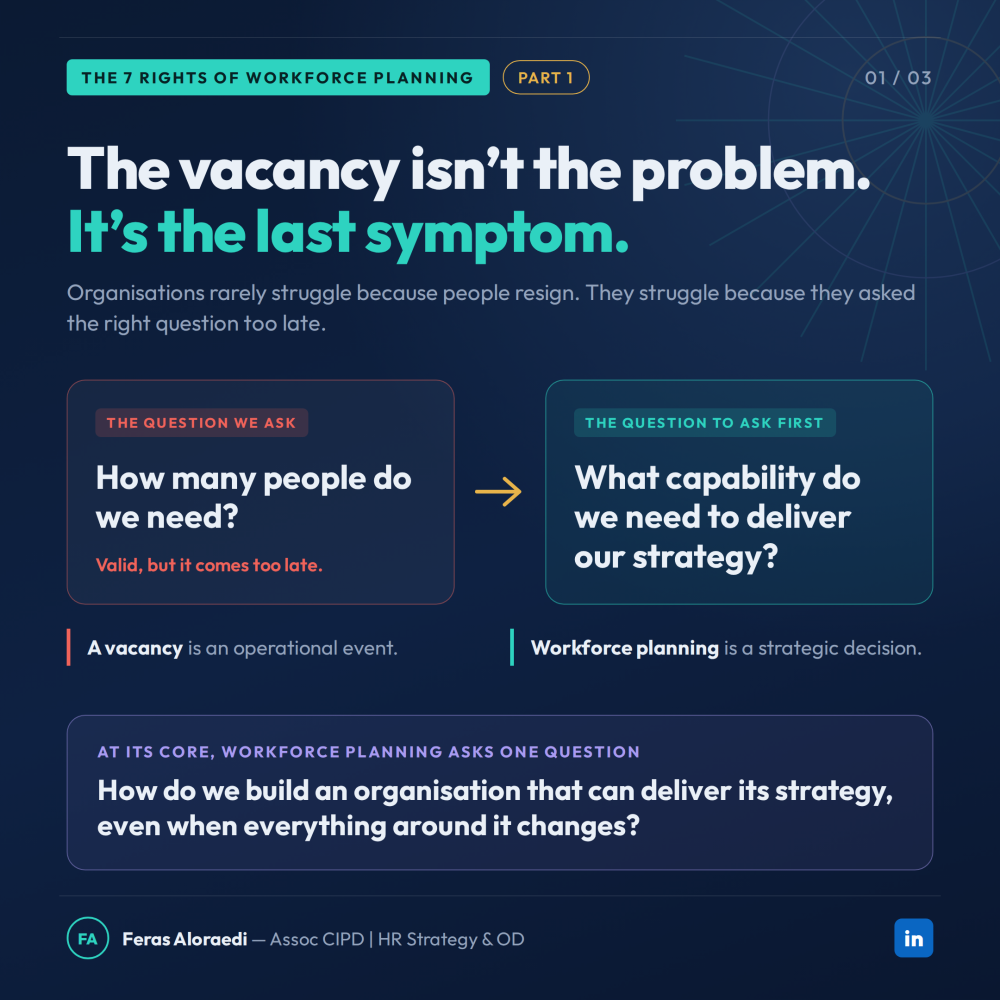
Workforce planning is a strategic decision. One looks at the empty chair. The other looks at the organisation three to five years out and asks which work will still exist, which roles will change, and which skills won’t be available when they’re finally needed.
Three horizons, three different questions. Near-term resource planning asks what we need right now: a resignation, a new project, a branch opening. Operational planning asks what next year requires: budget, expected turnover, roles to fill. Strategic planning asks what capability the strategy itself will need.
All three are necessary.
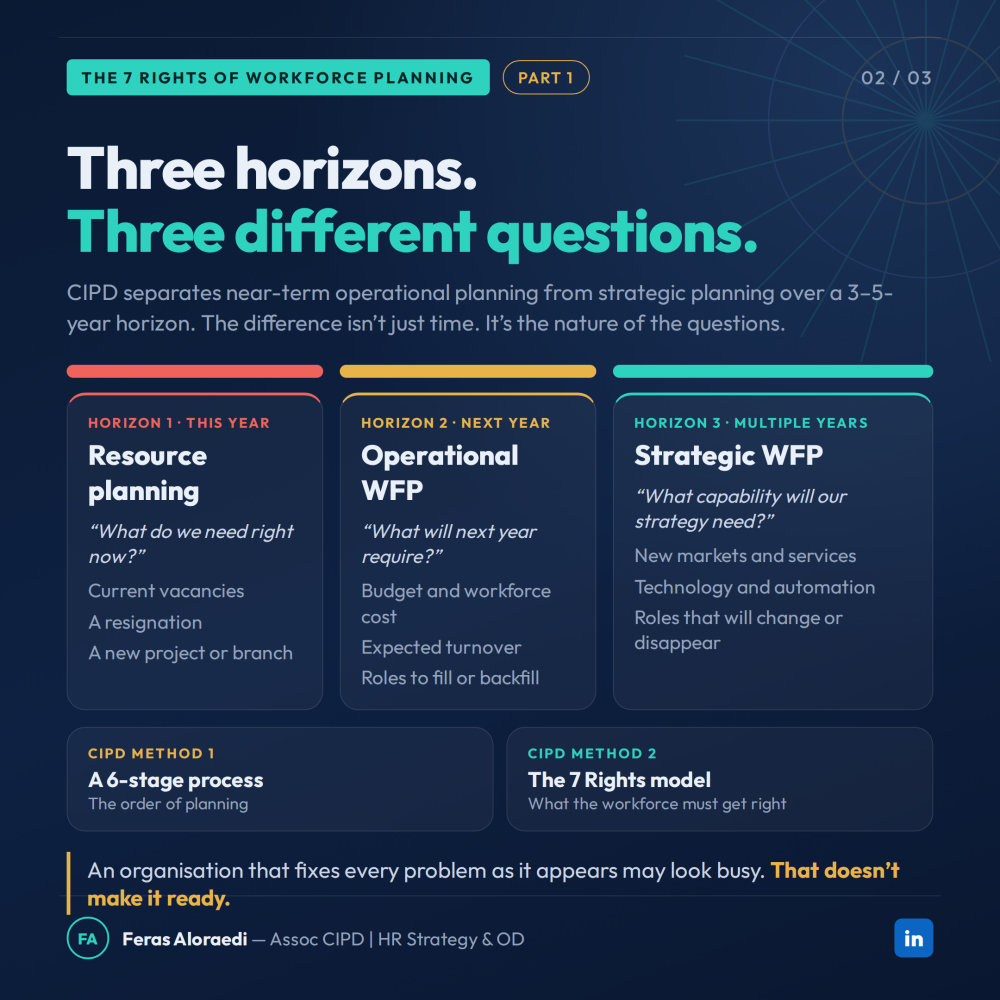
The risk is living permanently in the first one. An organisation that fixes every problem as it appears looks busy. That doesn’t make it ready.
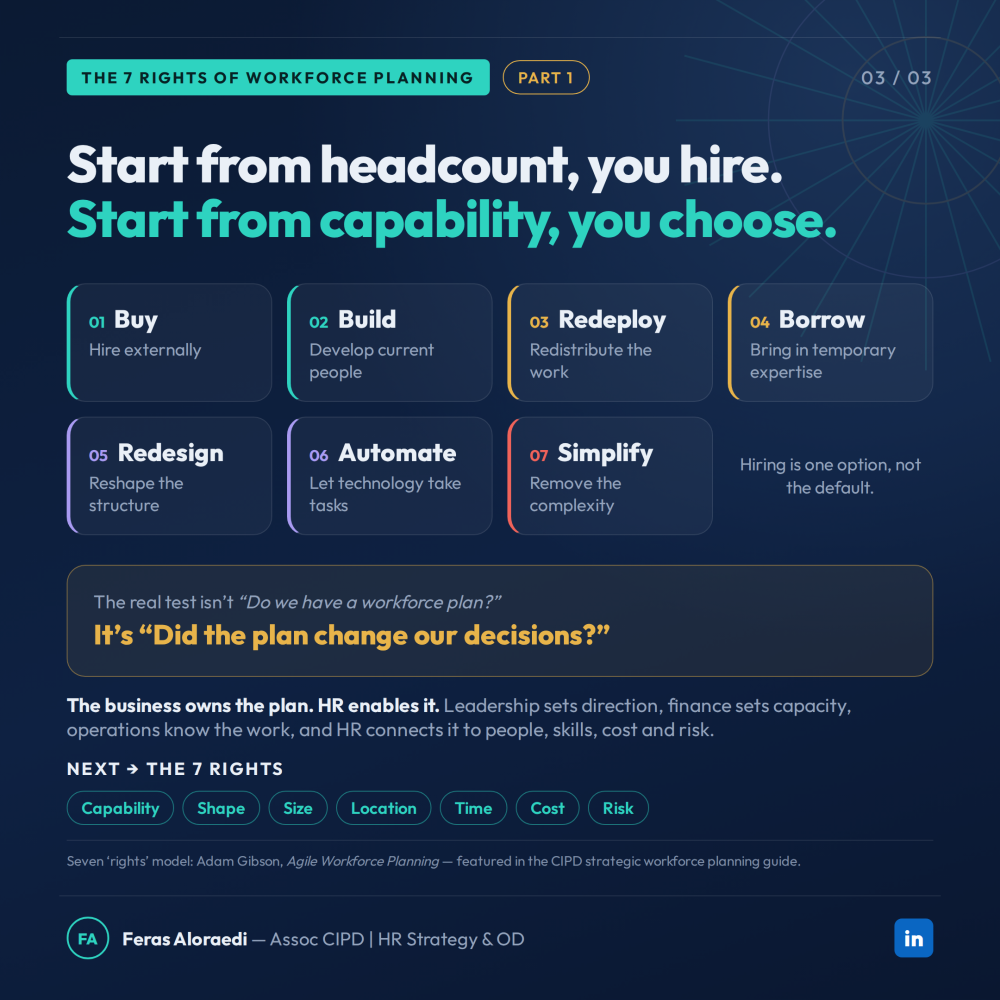
Start from headcount and you hire. Start from capability and you choose. Buy. Build. Redeploy. Borrow. Redesign. Automate. Simplify. Hiring is one option, not the default.
Sometimes a team asks for two more people to produce reports on time
and the real finding is that five near-identical reports are being rebuilt for three departments. That isn’t a staffing shortage. It’s an organisation paying people to reproduce the same information in different formats.
The plan is owned by the business, not by HR. Leadership sets direction, finance sets capacity, operations know the work, and HR connects all of it to people, skills, cost and risk.
The real test isn’t “Do we have a workforce plan?” It’s “Did the plan change our decisions?“
When the Numbers Are Right and the Plan Is Wrong
A manager presented his hiring request with full confidence. Numbers studied, roles defined, costs calculated, start date proposed.
Then one question: “Where will these people actually work?”
Silence. The roles sat in a region where those skills are hard to attract. No housing or transport plan. Salaries benchmarked against a different labour market.
The number was right. The roles were needed. The budget existed. The plan still couldn’t be executed.
That’s the quiet failure of workforce planning:
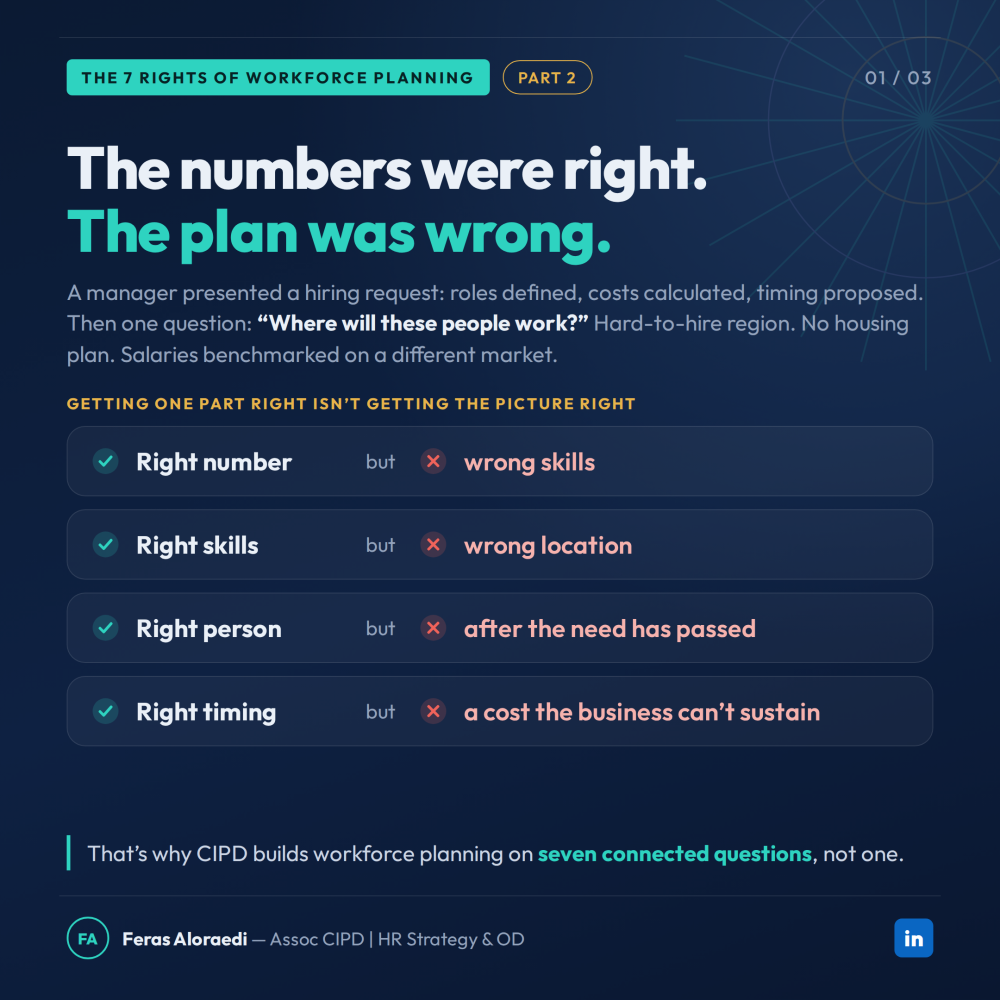
getting one part right and assuming you got the plan right.
You can have the right number without the right capability. The right capability in the wrong location. The right person after the need has passed. The right timing at a cost the business can’t sustain.
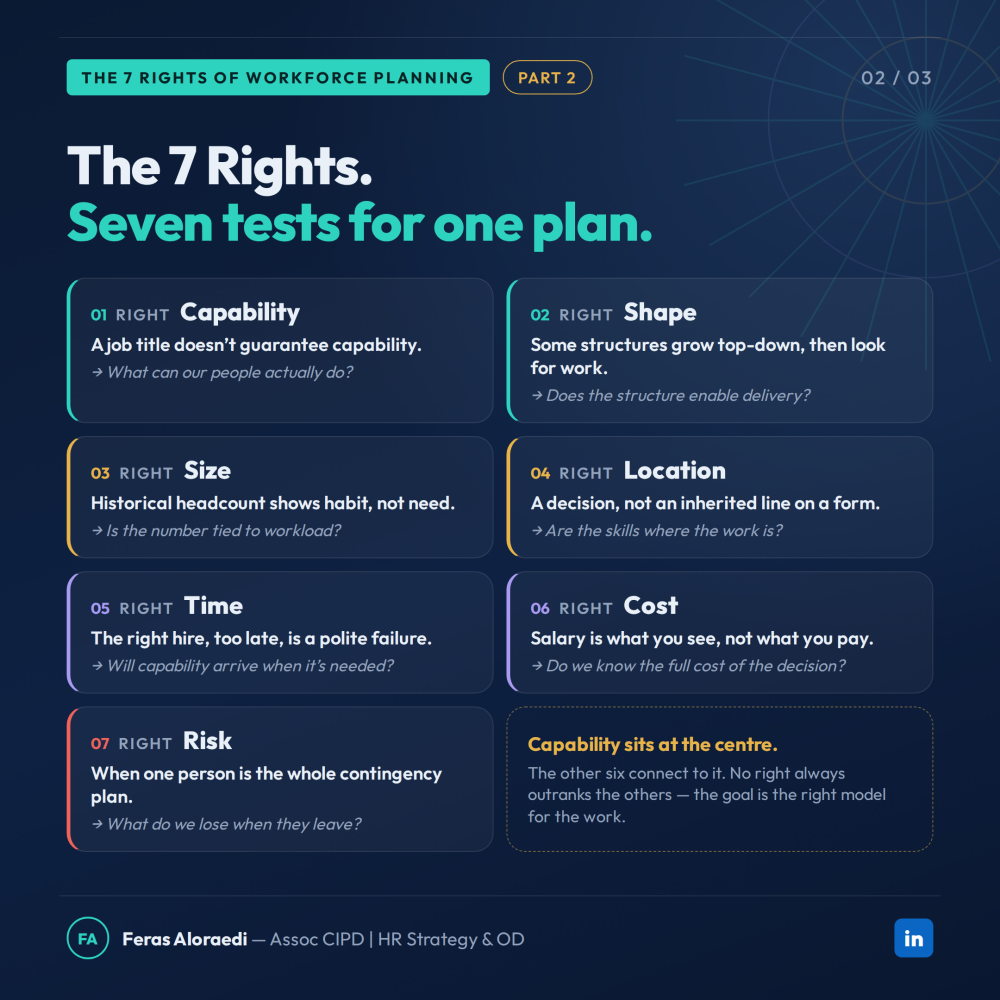
Which is why a workforce plan is tested against seven connected rights, with capability at the centre:
- Shape — the mix of leaders, specialists, layers and spans
- Size — tied to workload, not to history
- Location — a decision, not an inherited line on a requisition form
- Time — available when needed, for as long as needed
- Cost — the full cost of the decision, not the salary line
- Risk — at a level the business can absorb
Every fix moves the pressure.
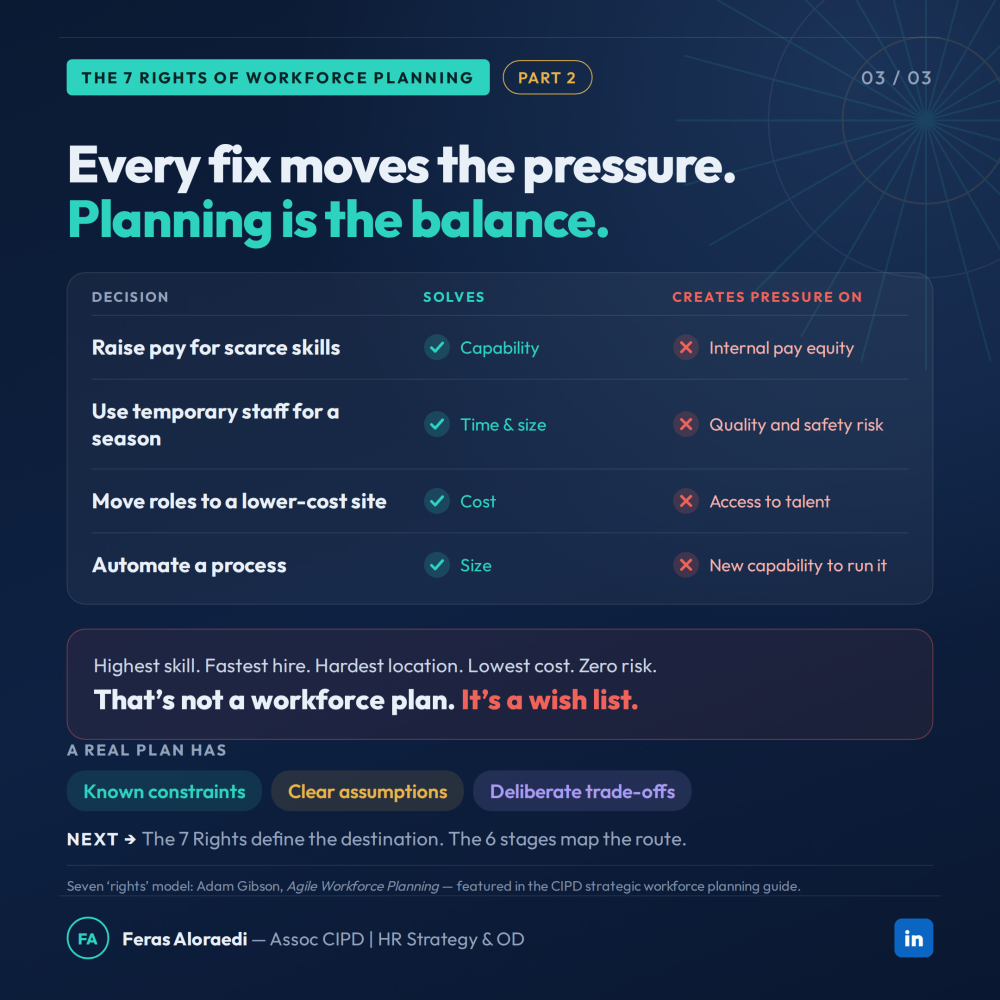
Raise pay for a scarce skill and you strain internal equity. Move roles to a cheaper site and you lose access to talent. Automate and you create a new capability to manage.
The highest skill, fastest hire, hardest location, lowest cost, zero risk — that isn’t a plan. It’s a wish list.
A real plan has known constraints, clear assumptions, and deliberate trade-offs.
Data Starts the Plan. It Shouldn’t Run It
Our plan is clear: we want to expand.“
Everyone agreed. Then the questions started. Finance heard revenue. Sales heard new markets. Operations heard capacity. IT heard a new system. And HR was asked to turn all of it into a headcount number.
That’s why the first stage of workforce planning isn’t forecasting. It’s building the baseline: knowing where the organisation actually stands before deciding who to take with it.
A baseline isn’t a headcount report.
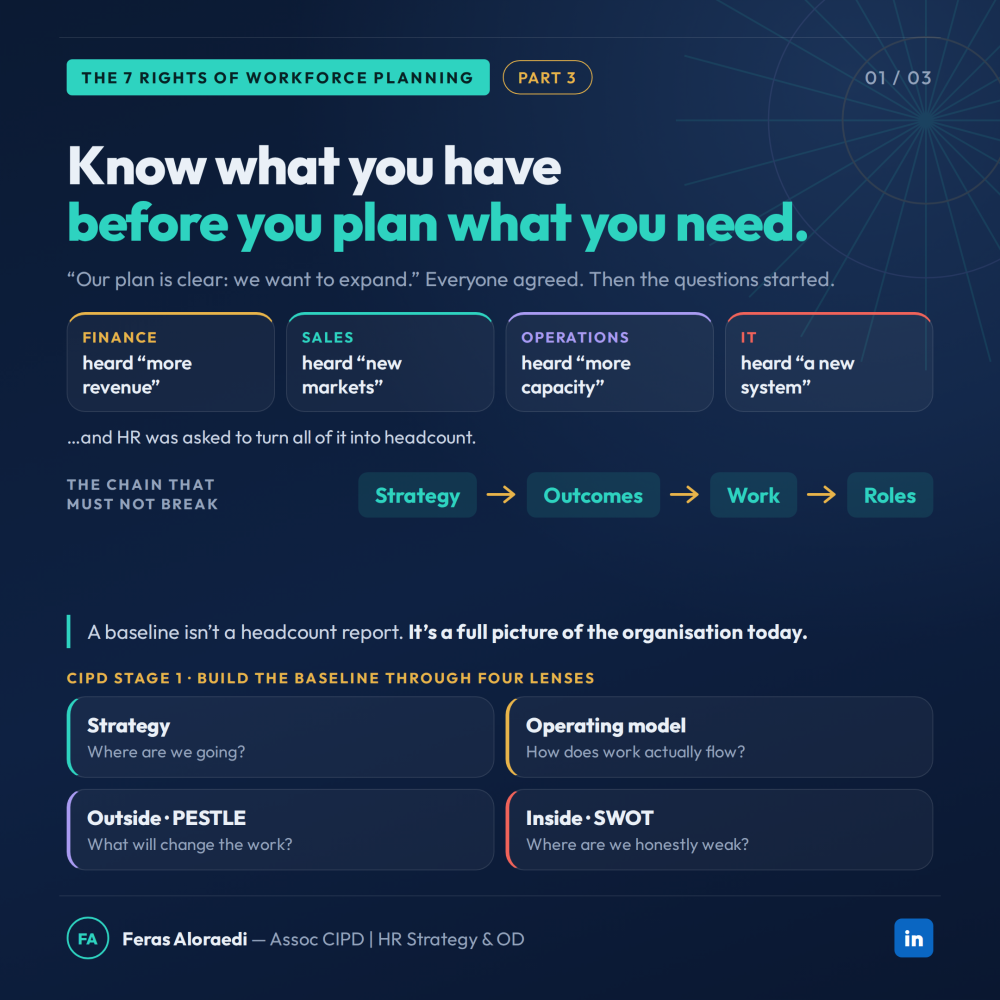
It’s a picture of the organisation today, through four lenses: the strategy, the operating model, the external forces that will change the work, and an honest view of internal strengths and weaknesses.
Then the data. Too little, and decisions run on impressions. Too much, and you get beautiful dashboards that change nothing. Four questions:
- Where does the data live? HR knows headcount. Operations knows workload. Finance knows cost. Data doesn’t respect org boundaries.
- How reliable is it? Outdated titles, optimistic self-ratings, and every exit logged as “personal reasons”.
- How often does it change? Planning five years ahead on old data is like driving by the rear-view mirror.
- Where are the gaps? Gaps don’t stop the plan. They’re an output of this stage.
Known gaps can be managed.
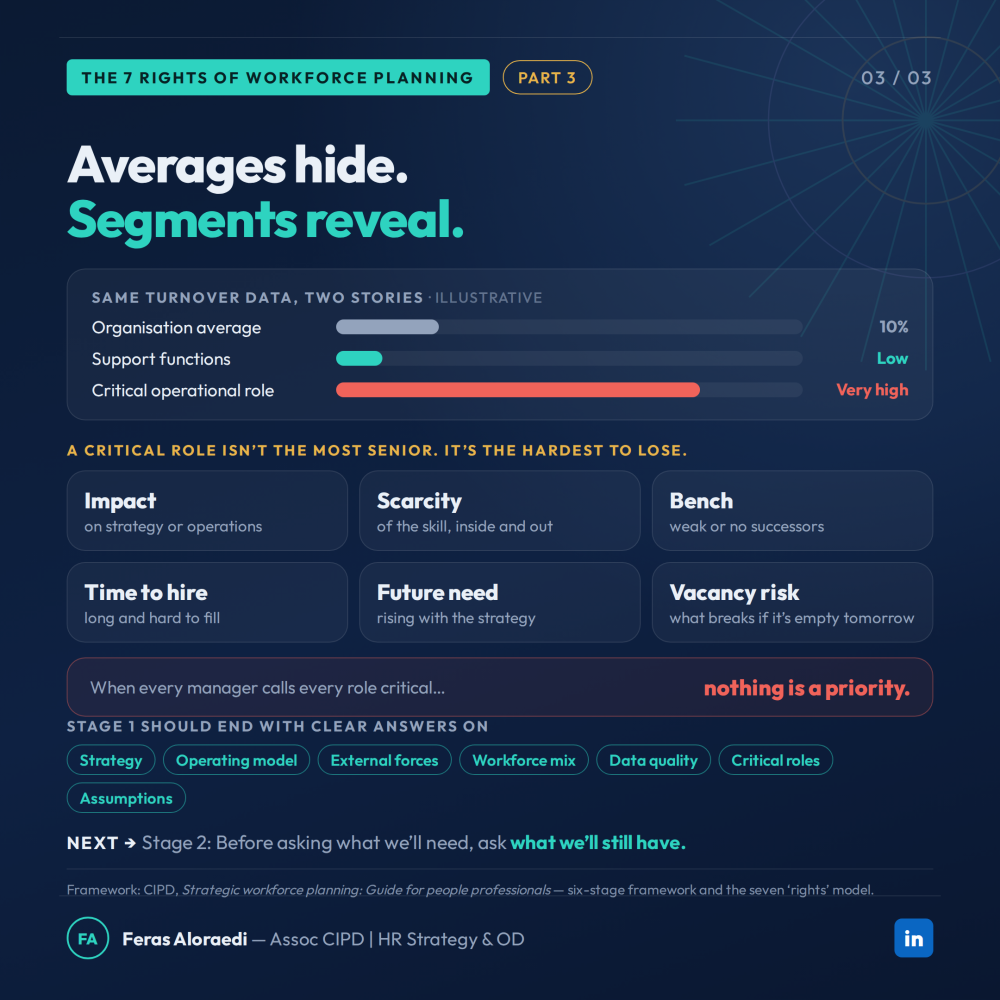
False certainty walks into the meeting wearing a chart. And remember that numbers tell you what happened; conversations tell you why.
Never read the workforce as one block. A 10% average turnover can hide a comfortable support function and a critical operational role losing people fast. Averages hide. Segments reveal.
Then the harder question: which roles carry disproportionate impact? Not the most senior, not the longest job titles. A critical role is the one whose absence hurts most and whose replacement takes longest. And when every manager insists every role is critical, the organisation doesn’t have priorities. It has a list.
Headcount Is a Snapshot. Supply Is a Forecast
A department has ten people. The system says ten. The near future says something else.
Two are approaching retirement. Three are quietly looking elsewhere. Two perform well, but their skills are drifting away from where the business is heading. And only one could step into the critical role if its holder left.
On paper: ten. In practice, far less capability than the number suggests.
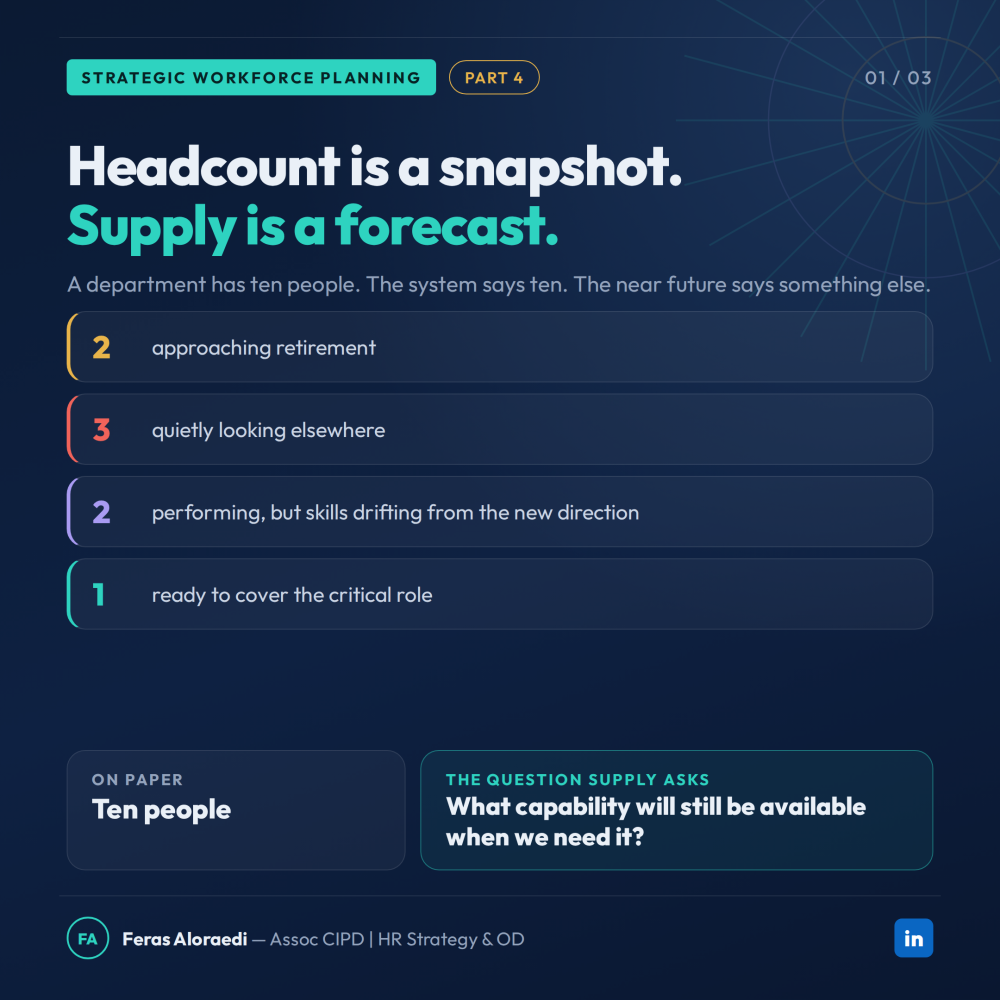
That’s why managing supply doesn’t ask “how many people do we have?” It asks “what capability will still be available when we need it?” The difference between those two questions is the difference between managing a payroll list and managing business continuity.
Counting people isn’t measuring supply. The quantitative view tells you how many sit in each role, how many could leave, how many reach retirement age. The qualitative view tells you what they can actually do, who could step into a bigger role, and where hard-to-replace knowledge sits.
Fifteen people in a job family sounds comfortable — until you find that only three hold the skill the new strategy needs. Supply isn’t fifteen. It’s three.
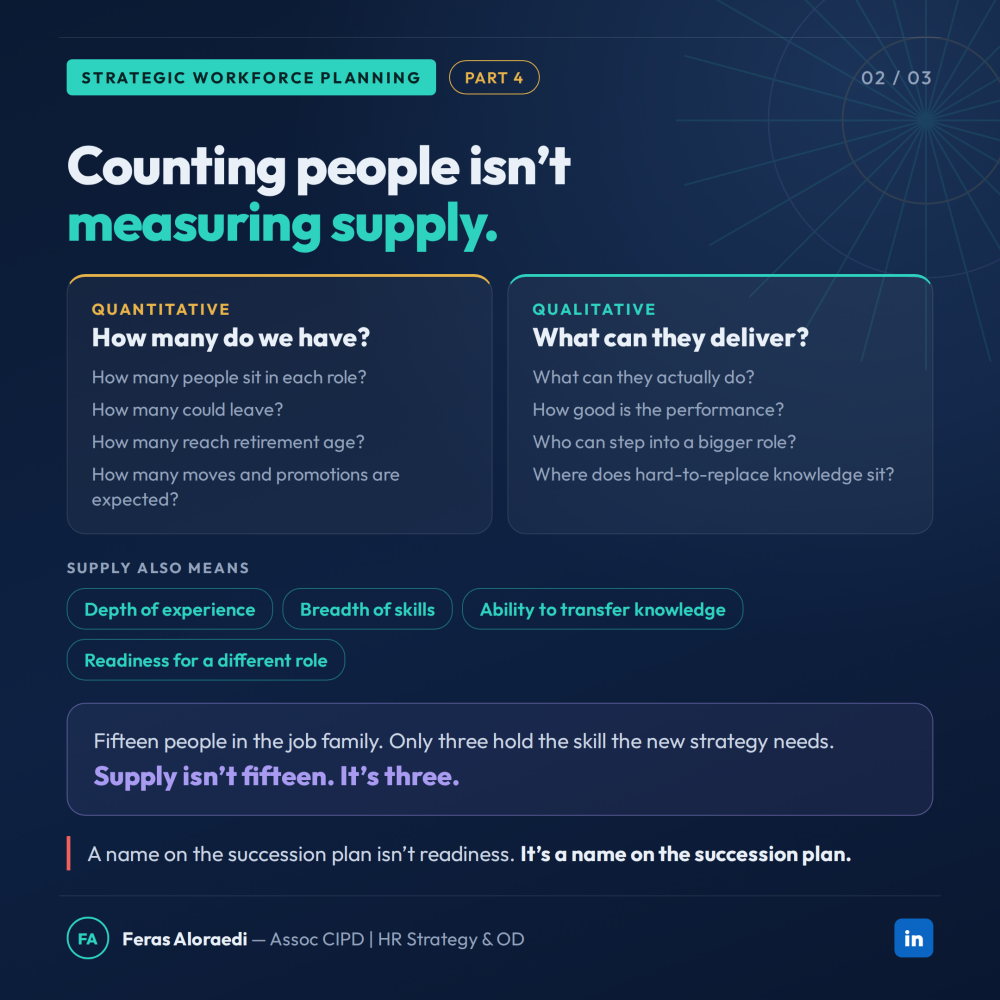
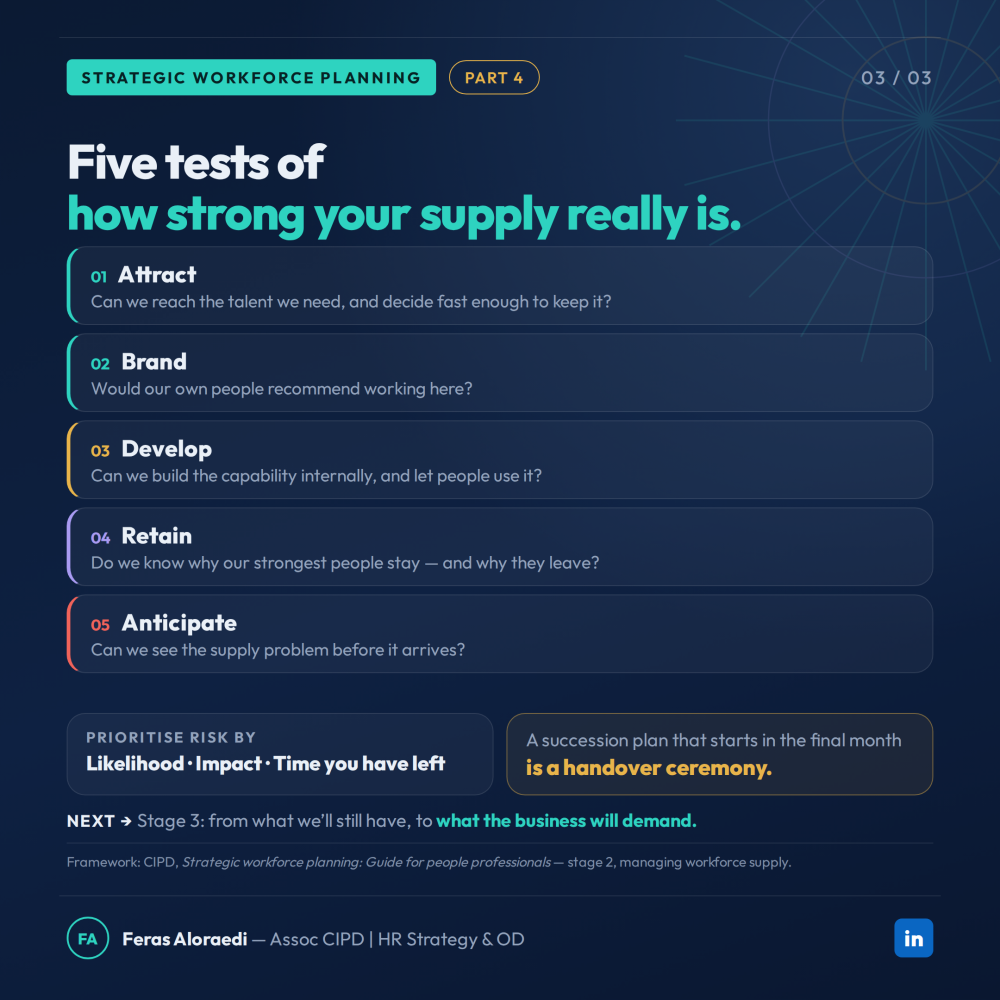
And presence isn’t readiness. A name on the succession plan is a name on the succession plan. Readiness takes exposure, real assignments, development and honest assessment. Knowledge doesn’t transfer when an expert explains what they know; it transfers when someone else does the work, gets it wrong, gets guided, and tries again. A succession plan that starts in the final month isn’t a plan. It’s a handover ceremony.
Resignations don’t start with the resignation letter either. They start when someone stops seeing a future, or their pay drifts from the market, or they lose confidence in their manager. The letter only documents a decision made much earlier.
None of this is about doubting anyone’s loyalty. It’s risk management, not judgement of intent. If a critical role has no successor and its holder is near retirement or holds a skill the market wants badly, that’s a risk — and the error belongs to the organisation that made continuity depend on one person staying.
Not every risk can be tackled at once. Prioritise by likelihood, impact, and how much time you have left. A gap you can close in a week is not the same as one that takes two years to build.
One Gap. Seven Levers
The gap analysis was finished. New skills needed in some roles. Shortages in some sites. Critical roles with no ready successors. And roles the new system would make redundant.
A manager looked at the results and said: “Excellent. Let’s start hiring.”
He wasn’t entirely wrong — some gaps genuinely need hiring. The problem was one word: all. A skills gap, a succession gap, a seasonal peak and weak productivity, all answered the same way.
Hiring is attractive because it has a start and an end: a requisition, an interview, an offer, a start date. Developing people, redistributing work, fixing the structure, transferring knowledge and improving productivity are messier — because they don’t ask the market to change. They ask the organisation to change.
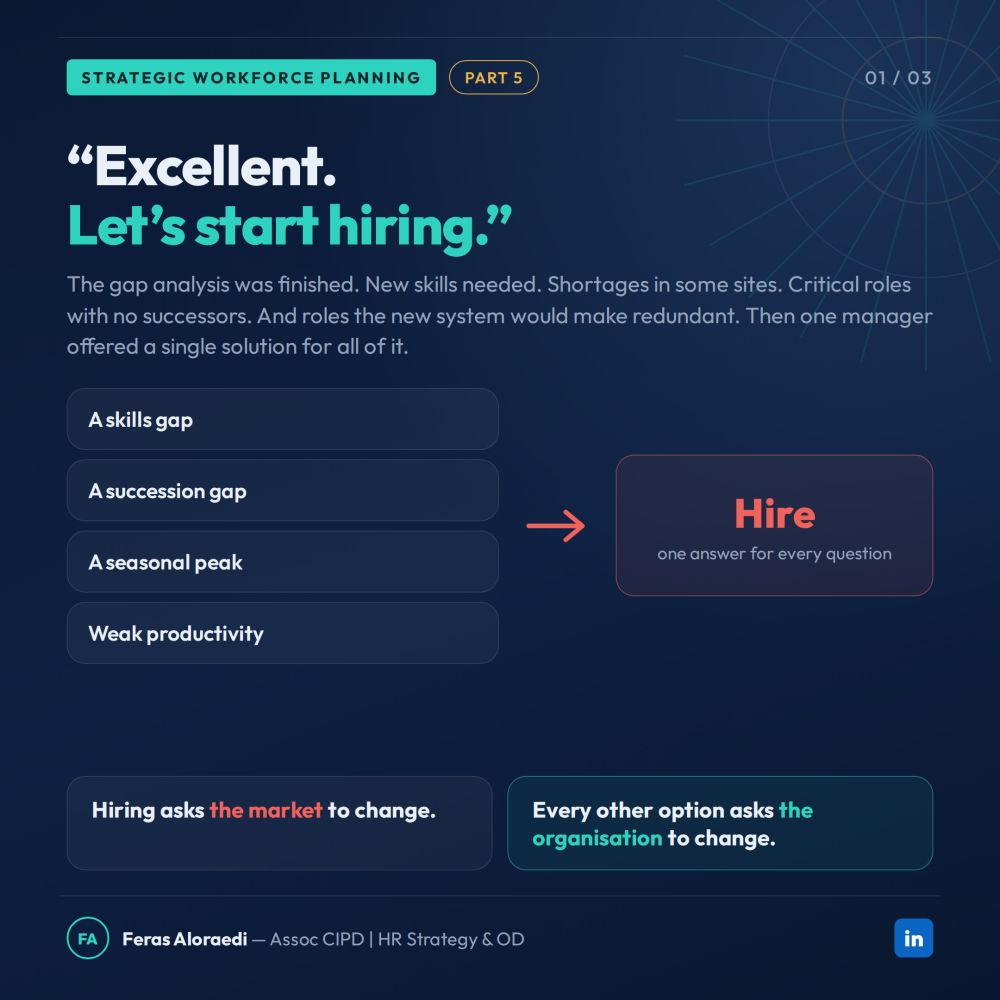
Once the gap is understood, the question isn’t “who do we hire?” It’s “what are the options for closing this gap, and which balances capability, numbers, timing, location, cost and risk best?”
There are seven levers. Five manage talent — Buy, Build, Borrow, Bind, Bounce — and two manage demand itself: Balance and Bot. They aren’t steps to follow in order. They’re lenses to think through before deciding.
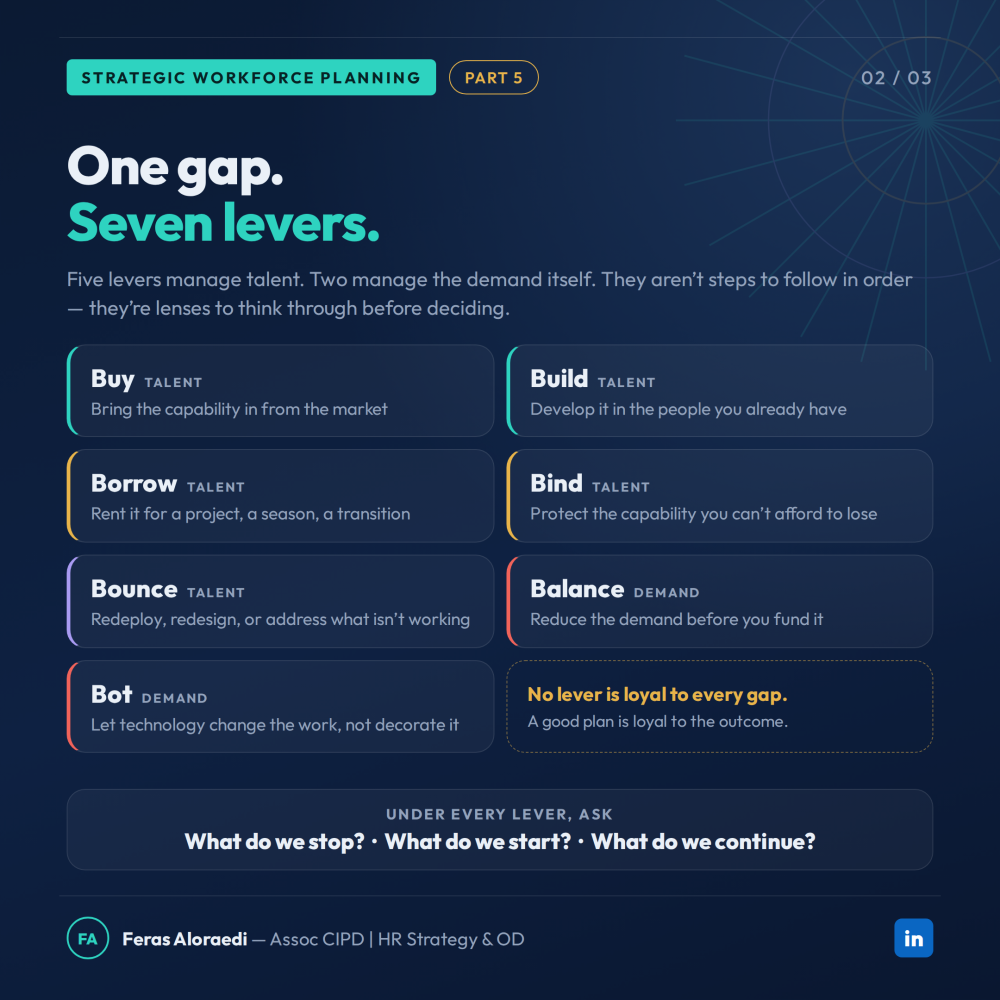
Buying is right when the capability doesn’t exist internally and can’t be built in time — but hiring into a role with high turnover doesn’t close a gap, it just speeds up the revolving door. Building is more sustainable and starts with the critical roles, but it takes months or years, so the best time to start is before the need is urgent. Borrowing gives flexibility, as long as the plan says which knowledge must stay in-house when the contract ends. Binding protects what you can’t afford to lose — though a counter-offer after a resignation is retention that arrived late. Bouncing moves capability to where it’s needed, and addresses what everyone has been avoiding. Balance asks whether the demand is real before funding it. And Bot changes the work rather than accelerating a bad process.
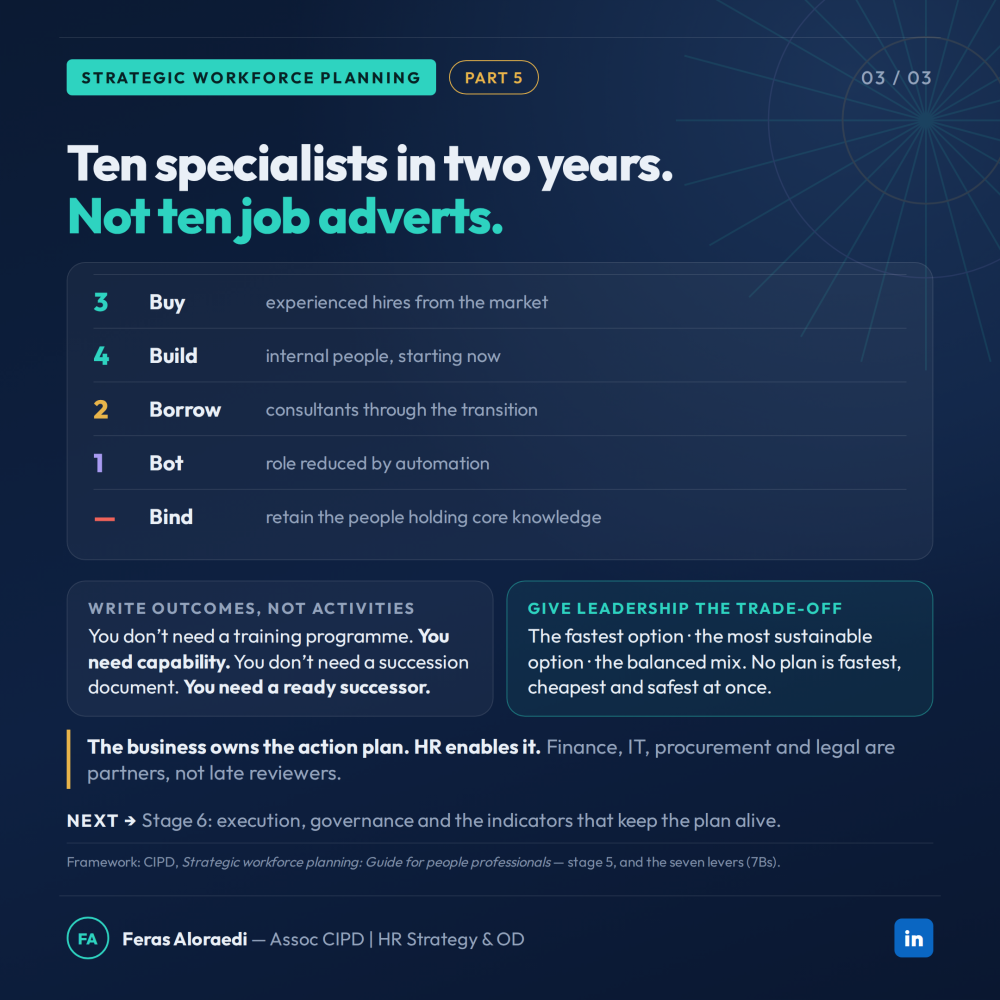
No single lever fits every gap. Ten specialists needed in two years might mean three hires, four people developed internally, two consultants through the transition, one role removed by automation, and a retention plan for the people holding core knowledge.
Write the plan in outcomes, not activities. You don’t need a training programme; you need capability. You don’t need a succession document; you need a ready successor. And give leadership the trade-off honestly: the fastest option, the most sustainable option, or the balanced mix. No plan is fastest, cheapest and safest at the same time.
The Analysis Was Right. Nothing Moved
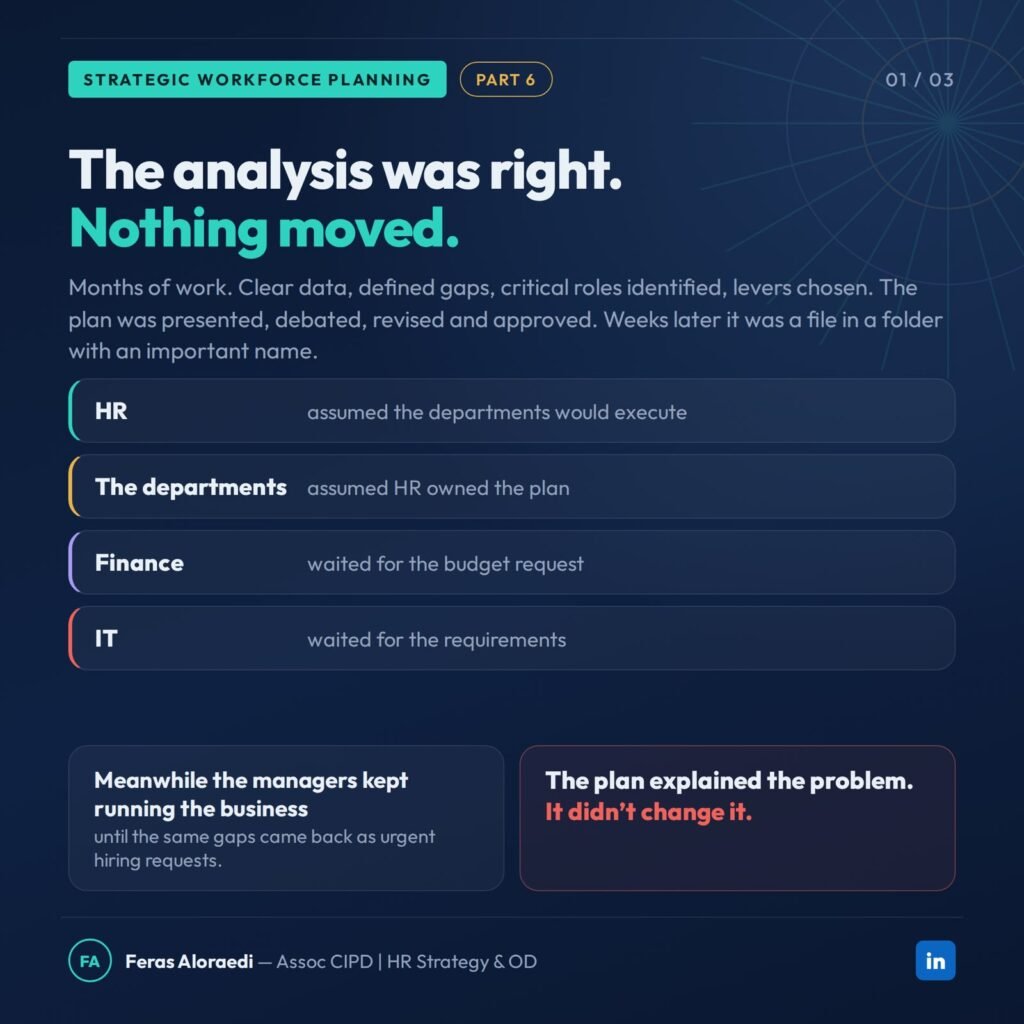
After months of work, the workforce plan was finished. The data was clear, the gaps defined, the critical roles identified, the levers chosen. It was presented, debated, revised and approved.
Weeks later, it was a file in a folder with an important name.
The analysis wasn’t weak. The recommendations weren’t wrong. The problem was simpler and far more dangerous: it was never clear who would do what.
HR assumed the departments would execute. The departments assumed HR owned the plan. Finance waited for a budget request. IT waited for requirements. And the managers kept running the business — until the same gaps came back as urgent hiring requests.
The plan explained the problem. It didn’t change it.
HR can run the methodology, analyse the data, connect the parties and track the indicators. It cannot redesign an operational process, change a service level, implement a system, set the investment budget, or develop a person whose manager never lets them apply what they learned.
So every outcome needs a name. Not someone who keeps the latest version of the file, but someone who is answerable if it doesn’t happen. RACI helps here — Responsible does the work, Accountable owns the result and the decision, Consulted must be asked, Informed must be told. Most execution failures start when those blur: five people doing the work and nobody owning the result, or a decision-maker treated as an adviser while the initiative waits.
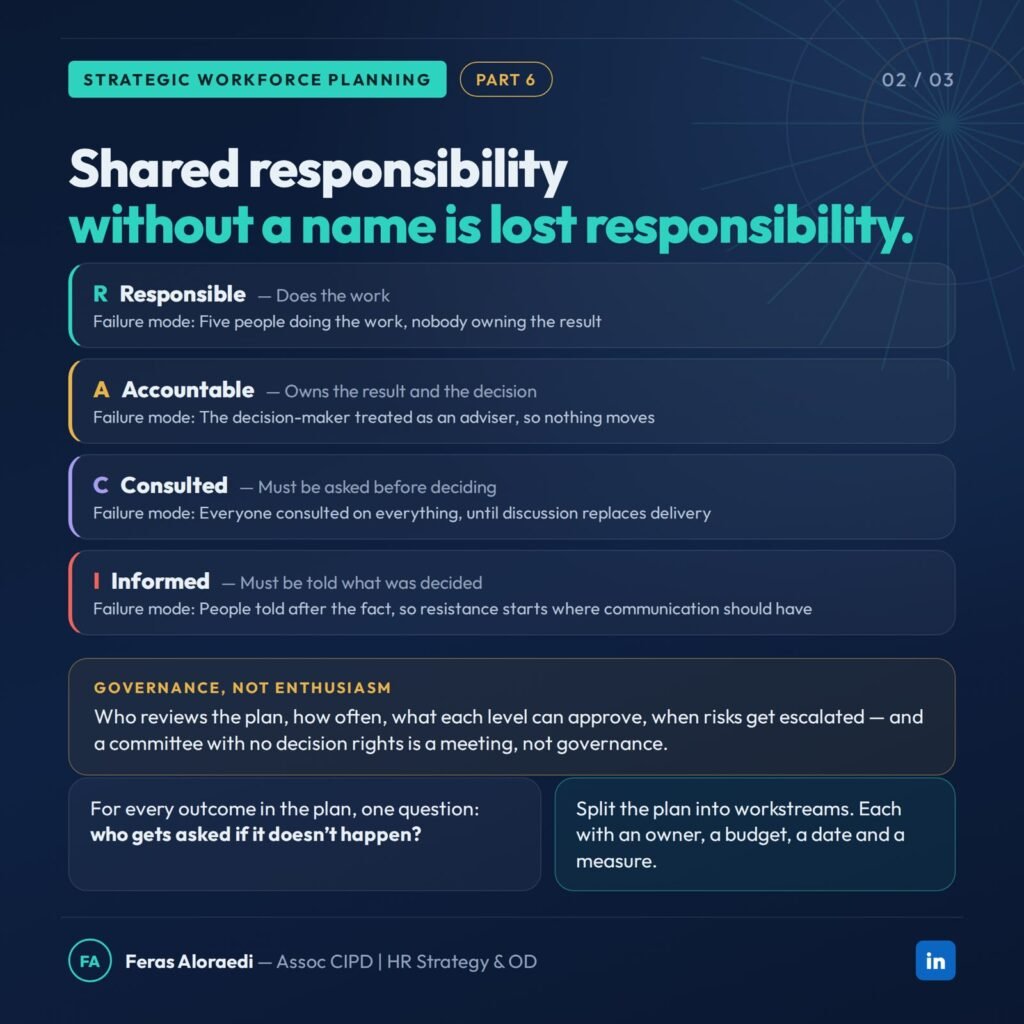
Then split the plan into workstreams — recruitment, capability building, succession, structure, redeployment, automation, retention, seasonal labour — each with an owner, a budget, a timeline, dependencies and a measure. And don’t mistake the activity finishing for the benefit arriving. Training can end without readiness improving. A system can go live without manual hours falling. A new structure can be published while decisions still travel the old routes.
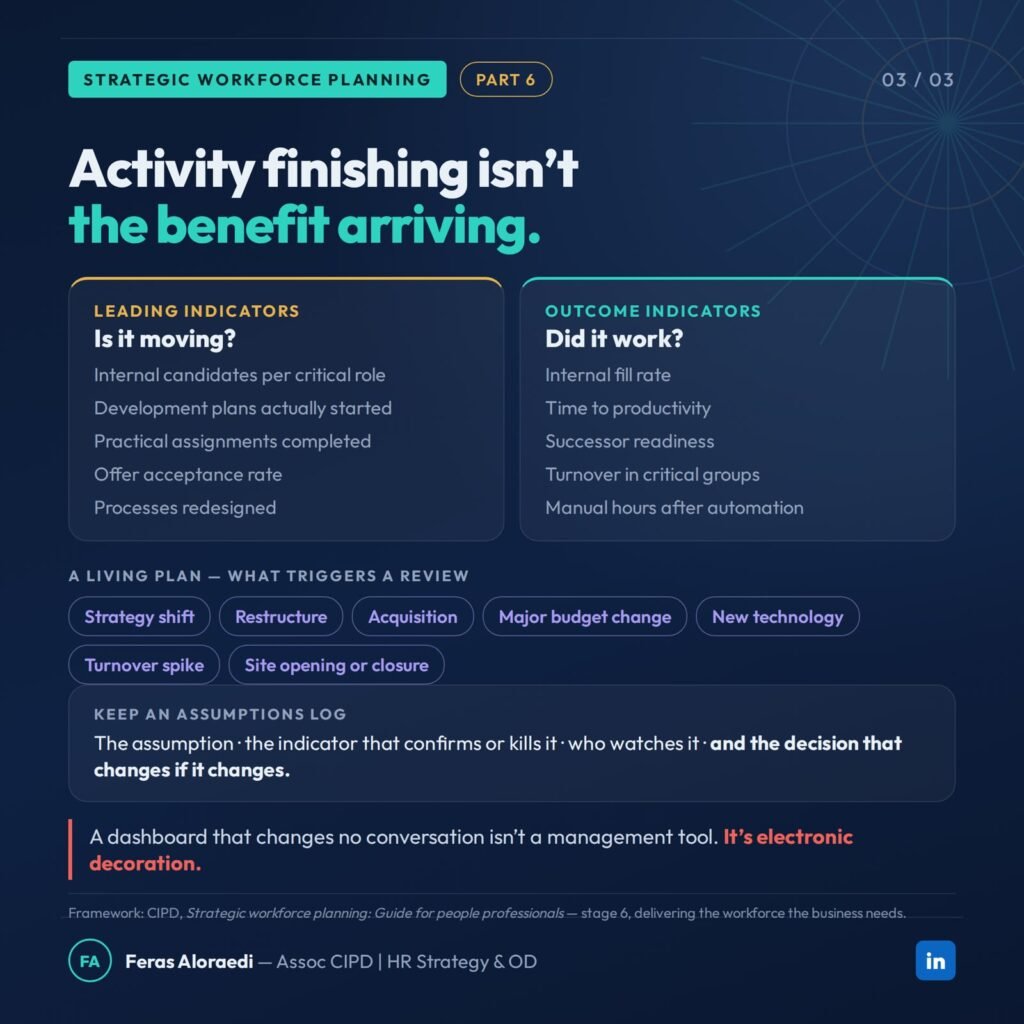
Track both leading indicators (is it moving?) and outcome indicators (did it work?). Keep an assumptions log: the assumption, the indicator that confirms or kills it, who watches it, and the decision that changes if it changes. A dashboard that changes no conversation isn’t a management tool. It’s electronic decoration.
And don’t wait for perfect data to start. Pick one critical job family or one site under pressure, use what you have, state the assumptions, and learn. A plan doesn’t mature before it starts. It matures because it started.
We began this series with an empty desk. Six stages later, the empty desk turns out to be the visible part of something else: a strategy never translated into skills, a critical role with no successor, a weak process solved by adding people, or a plan that stopped at approval.
Workforce planning doesn’t prevent every resignation or predict the future in detail. It makes the organisation less dependent on luck.